View on Threads

On a good note: June 2025 was the first in six years wherein we did not hit 100º.
Below is a photo of me beating the heat over Memorial Day. We're hoping to get back to Colorado and New Mexico before the summer is over.
 |
| Cinnamon Pass in Colorado |

Fingers crossed over here that said storm was the worst of the year for Austin. In my experience, the weeks around Memorial Day have usually produced to worst storms here.
Gulf/Atlantic coast readers and/or property owners: as you know, hurricane season is here. NOAA is predicting a 60% chance of above average activity for 2025.
Note: remember, keep your property insurance coverages up to date and at the appropriate levels.
I was recently on Reddit and found a link to the oral history of Thundercloud Subs. I enjoyed reading it, and now you can too. Also, if I write a round of Austin trivia this article has the type of factoids I like to ask about.
In case you are wondering what will be happening to the 3,994 square foot terrance which used to be the Chase Sapphire Lounge at the Austin airport: it will be reopening as available to the flying public from 8a-8p on a daily basis. The linked KUT article mentions the airport is building a second terrance, and said terrance will be in part occupied by the American Airlines Admirals Club.
The article also mentions that the airport is looking for another premium credit card club. My vote is for an American Express Centurion Lounge. I like the Centurion Lounges I've visited, for one. And from the Amex perspective: they like to go with local food themes of which Austin offers many options. A taco station, or perhaps a barbecue buffet? I'm no chef but these seem obvious (and delicious).
Yes, if you have followed the articles on REAL ID then you know the deadline has been postponed a few times in the past. The TSA published a final rule on REAL ID earlier this year, setting the deadline for May 7th. On and after said date you'll need a REAL ID driver's license or a valid passport to board a commercial flight (including services like JSX) in the US.
If you have questions, you can visit the Department of Homeland Security's FAQ page on REAL ID.
There is still time to vote in the Austin Chronicle's Best of Austin poll. You have until tomorrow night at 11:59p to vote and/or change your vote.
The old CapMetro payment app has been retired, and riders who want to pay via app must now use the Umo app. Tap-to-pay (which lets riders pay with Apple Pay, Google Pay, credit, or debit cards) is forthcoming at some point. I haven't ridden the bus in a while, but I recall the old app being somewhat cumbersome. I'm looking forward to the tap-to-pay system, which if anything like London's TFL payment system should be pleasant to use.
CapMetro is now recommending using the Transit app for trip planning in Austin. You can also try City Mapper, which I used on my last trip to London and found to be highly useful.
Through September 30th, Delta is offering an enhanced status match to Southwest A-List and A-List Preferred members. This will get you Gold and Platinum Medallion Level respectively in SkyMiles. Check the site for the specific details on how to do this and for how long the status match will last. Also, if you aren't a SWA frequent flier, Delta offers a status match with many other airlines.
Last Fall, when I went to London, I did a status match in which my SWA A-List Preferred (I have since been demoted to A-List not special) got me United's Gold level. This came in handy as with it I was able to get lounge access for 3 of the 4 total flights (for the flight out of London, I used an Amex affiliate's lounge). I was able to eat and drink for free (other than tips) at airports going to and coming home from the UK, which was quite the bonus. I mention this because you too might be able to unlock something nice if applying a status match from your frequent flier program to one of an airline you don't use often.
Here's an update of new non-stops from Austin, including but not limited to:
In case you missed the news, here's a reminder that Lyft is ending its partnership with Delta on April 7th. Dollars spent on Uber rides will henceforth be able to earn Delta SkyMiles. Lyft will continue to partner with Hilton offering hotel points for dollars spent on rides. They also have partnerships with Alaska Airlines and Bilt Rewards, which I assume they are keeping.
For a while I've had it set so that my Lyft account fed Delta and Uber fed into Marriott Bonvoy. The latter has been a good deal as I almost always book Uber Comfort (or above) and that gets triple Bonvoy points for every dollar spent. However, double SkyMiles per dollar on Uber Comfort is tempting if you frequently fly on Delta (the Points Guy is currently valuing Delta points at 1.2¢ and Marriott Bonvoy points at .7¢).
On a personal note vis a vis Uber: what I am sure of is that despite their pushing of Waymo, I will be sticking with human driven cars.

REI is having its usual March sale. Members get 20% off one regular and one outlet item between 3/14-3/24. Also, as I've mentioned before, the cobranded Mastercard is great if you are a frequent flier at REI (no annual fee, 5% back on REI purchases and 1.5% on everything else, access to Capital One shopping discounts). Also, it's the only no annual fee card I have which also has no foreign transaction fees.
On a different note, I have a lot of thoughts about the changes going on at Southwest Airlines which I hope to address in a post sometime soon.


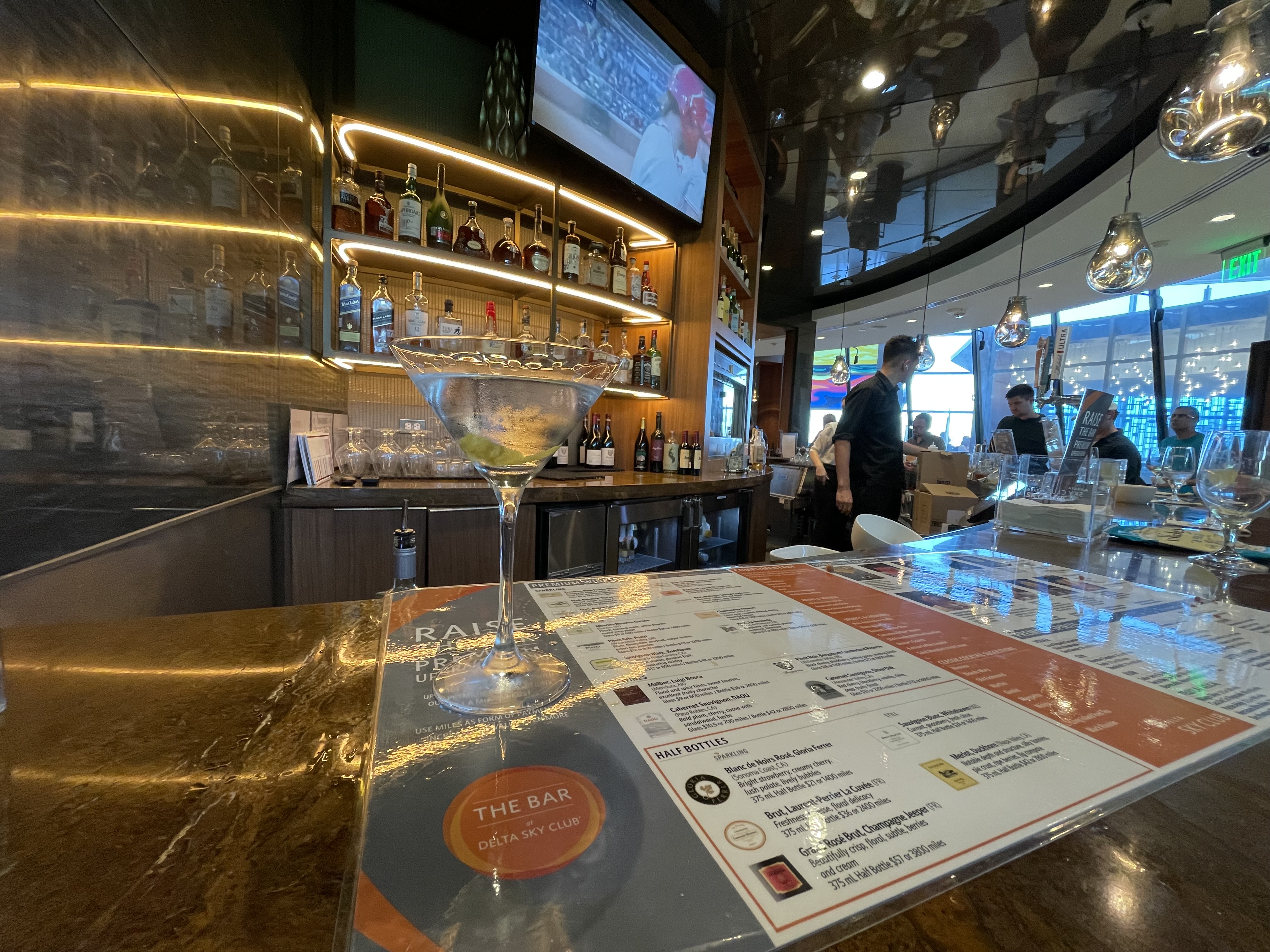 |
| The Delta Sky Club in Austin |
According to KXAN, Delta will launch a seasonal flight from Austin to Cancun running from December-April. This will be Delta's first international flight from Austin in 14 years. Delta continues to increase routes from Austin (8 new this year) and is on track to replace American as the #2 carrier operating out of Austin's airport. Southwest remains firmly in first place in terms of flights from our airport.
Read the previous post for more information about Sky Club access and the American Express relationship with Delta.
 |
| Delta Sky Club in Austin |
Apparently its last day will be on March 19th. I don't know why it's closing, but maybe having an outdoor terrace in often hot Austin wasn't working out. There do not appear to be plans for it to re-open.
Right now we still have American Admirals Club, United Club, and Delta Sky Club options. I'd love to see an American Express Centurion Lounge end up in the airport at some point. Mostly indoor and air conditioned, of course. Furthermore, if you don't want to deal with getting lounge access we do have a good selection of restaurants for snacks and pre-flight beverages.
Speaking of American Express: American Express Platinum (business or personal) up to 10 times per year regardless of status with Delta SkyMiles or having a Delta cobranded card (also from Amex). I like the Delta Sky Club in Austin, but as a Platinum Card user with limited passes available I'd rather have my pre-flight hang out at Second Bar + Kitchen or Parkside in order to save the pass for later (say, Salt Lake City).
The city will be holding four informations from January 21-27 to discuss proposed changes to Austin's short term rental regulations. Here are the dates:
The city would prefer that potential attendees register in advance. There will also be public hearings at City Hall which you can attend on February 4th, 6th, and 27th (follow link for more details).
The impetus for these upcoming rule changes is a 2023 ruling from the Western District of Texas which said that it was unconstitutional for Austin to have stopped issuing STR Type 2 licenses. The city has been issuing STR Type 2 licenses since then. Proposed rule changes could include collection of hotel tax, where in the ordinances the regulations are placed, density rules, and so forth.
The temperatures in Austin are projected to drop below freezing on Saturday night, so now seems like a good time to think about cold weather preparations for your house. You can go back to watch this video about how to properly drip your faucets: How and When to Drip Your Faucet During Winter Weather
It rarely get extremely cold in Austin, but if you were here in 2021 for the "snowpocalyse" or in 2023 for the horrible ice storm you know winter weather can go off the rails here. Tuesday (currently) has a projected high of 32º and a 40% chance of snow. Fortunately it's supposed to get to a sunny 46º on Wednesday, but here's are a couple of infographics anyway (who knows, you might really need these in Austin in February or be tuning in from a place with more intense snow):


Note: Also, if you need winter gear REI is a good place to get it. Purchases by members can be eligible for an up to 10% dividend, and all REI purchases on the REI credit card earn 5% back in store credit. Neither REI nor Capital One pay me to tell you this; I'm sharing because I've saved a lot of money on quality gear and earned quite a bit of store credit over the years by shopping strategically there.
Welcome to Austin Eras, the podcast that unravels Austin's transformation into a 21st-century boomtown and explores its potential future. Brought to you by Collective Advisors, Austin Eras takes you on a journey through the city's evolving landscape and rich history, offering insights into its dynamic past, present, and future.

Yes, I'm pretty sure Elvis died in 1977. I don't think he lives on a UFO with Bigfoot or anything like America's most reputable tabloids might have one believe. Who knows? What I can say is (1) if you like classic Americana attractions, (2) you like even just a few Elvis songs, and (3) you find yourself in the Memphis area, then swing by Graceland.
We visited the compound in 2010 while on a road trip back to Austin (we were driving back from Illinois, on the trip wherein I discovered just how cold winter gets up there). I was not expecting much from Graceland, thus it was pleasantly surprising to find out how much fun the tour is. Highlights for me included the Trophy Building and (of course) the airplanes. If memory serves, there is a minor upcharge for the airplane tour. Pay it, as this is the best part (I am an aircraft enthusiast, so take this rec with a grain of salt). Back to the Trophy Building: it's pretty cool and definitely drives home the impression of Elvis' success as a musician.
There are other things to do in Memphis. There is, of course, Beale Street, along with the ducks at The Peabody Hotel and the scale model of the Mississippi River at Mud Island. But, this is Elvis' birthday and I think he'd have been most amused by the Bass Pro Shops in the enormous Memphis Pyramid (a steel and glass edifice which rivals the majesty of the Luxor in Las Vegas). The Memphis Pyramid was once the home of the Memphis Grizzlies as well as being a concert venue. To my knowledge, this and the Luxor are the best pyramids the United States has to offer and I like to think that if Elvis had lived into the 1990's he would have suited up and rocked both venues in some kind of crazy retirement tour.
 |
| In DKR, Not a Sports Bar |
A couple of notes on the Eater post:

Starting this week, Americans traveling to (and through) the United Kingdom will need to fill out an application for the new electronic travel authorization (ETA). The "through" part is important to note, as even fliers stopping in the UK for a layover will need an ETA. Applications can be done online or through an app (it appears they would greatly prefer you apply through the phone app). The cost is £10. For more information and details on the application and what an ETA permits, you can visit the ETA specific webpage of the UK Home Office.
 |
| A Bad Day for Verstappen Back in 2016 |
The 2025 Formula racing schedule is out. US races are:

You may have already seen the list of Austin restaurants closing in 2024. There were many places on that list which will be missed. However, you can feel better knowing that Austin has plenty of new restaurants on the way in 2025. The Austin-American Statesman has profiled seventeen of them which they think are worth noting (I'd knock it down to 16, as one will be a private club).
Personally, I'm most excited about the return of Katz's (to its original location, no less). Its absence has been missed by me and several of my friends.

The travel blog A View From the Wing has gone into detail about how the Southwest Companion Pass will work under the new assigned seating rules set to go into effect in 2026. If you aren't familiar with the Companion Pass: it allows you to designate a "companion" who will fly with you for free (excluding minor airport fees and the possible upgrade charges) on any flight throughout the year you have it. For our Austin located household's domestic (plus Mexico) air travel needs, this is the best deal we've run across.
2024 was a slow year for us to travel together, and we were still able to use it on three trips. It would have been five, but for some last-minute scheduling conflicts (we'll have 2025, Nashville and Santa Fe). I did end up in Santa Fe and Nashville this summer, but the former was a camping road trip with friends and the latter a cross country road trip helping family move. Both stops were fun, with many enchiladas and BBQ items consumed in their respective locales.
