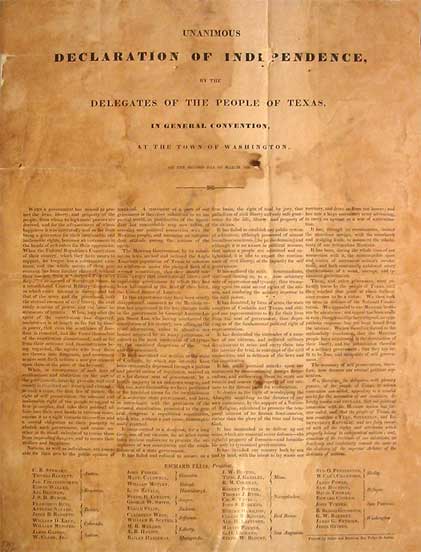
In honor of Texas Independence Day, which is tomorrow, here is the Texas Declaration of Independence:
When a government has ceased to protect the lives, liberty and property of the people, from whom its legitimate powers are derived, and for the advancement of whose happiness it was instituted, and so far from being a guarantee for the enjoyment of those inestimable and inalienable rights, becomes an instrument in the hands of evil rulers for their oppression.
When the Federal Republican Constitution of their country, which they have sworn to support, no longer has a substantial existence, and the whole nature of their government has been forcibly changed, without their consent, from a restricted federative republic, composed of sovereign states, to a consolidated central military despotism, in which every interest is disregarded but that of the army and the priesthood, both the eternal enemies of civil liberty, the everready minions of power, and the usual instruments of tyrants.
When, long after the spirit of the constitution has departed, moderation is at length so far lost by those in power, that even the semblance of freedom is removed, and the forms themselves of the constitution discontinued, and so far from their petitions and remonstrances being regarded, the agents who bear them are thrown into dungeons, and mercenary armies sent forth to force a new government upon them at the point of the bayonet.
When, in consequence of such acts of malfeasance and abdication on the part of the government, anarchy prevails, and civil society is dissolved into its original elements. In such a crisis, the first law of nature, the right of self-preservation, the inherent and inalienable rights of the people to appeal to first principles, and take their political affairs into their own hands in extreme cases, enjoins it as a right towards themselves, and a sacred obligation to their posterity, to abolish such government, and create another in its stead, calculated to rescue them from impending dangers, and to secure their future welfare and happiness.
Nations, as well as individuals, are amenable for their acts to the public opinion of mankind. A statement of a part of our grievances is therefore submitted to an impartial world, in justification of the hazardous but unavoidable step now taken, of severing our political connection with the Mexican people, and assuming an independent attitude among the nations of the earth.
The Mexican government, by its colonization laws, invited and induced the Anglo-American population of Texas to colonize its wilderness under the pledged faith of a written constitution, that they should continue to enjoy that constitutional liberty and republican government to which they had been habituated in the land of their birth, the United States of America.
In this expectation they have been cruelly disappointed, inasmuch as the Mexican nation has acquiesced in the late changes made in the government by General Antonio Lopez de Santa Anna, who having overturned the constitution of his country, now offers us the cruel alternative, either to abandon our homes, acquired by so many privations, or submit to the most intolerable of all tyranny, the combined despotism of the sword and the priesthood.
It has sacrificed our welfare to the state of Coahuila, by which our interests have been continually depressed through a jealous and partial course of legislation, carried on at a far distant seat of government, by a hostile majority, in an unknown tongue, and this too, notwithstanding we have petitioned in the humblest terms for the establishment of a separate state government, and have, in accordance with the provisions of the national constitution, presented to the general Congress a republican constitution, which was, without just cause, contemptuously rejected.
It incarcerated in a dungeon, for a long time, one of our citizens, for no other cause but a zealous endeavor to procure the acceptance of our constitution, and the establishment of a state government.
It has failed and refused to secure, on a firm basis, the right of trial by jury, that palladium of civil liberty, and only safe guarantee for the life, liberty, and property of the citizen.
It has failed to establish any public system of education, although possessed of almost boundless resources, (the public domain,) and although it is an axiom in political science, that unless a people are educated and enlightened, it is idle to expect the continuance of civil liberty, or the capacity for self government.
It has suffered the military commandants, stationed among us, to exercise arbitrary acts of oppression and tyrrany, thus trampling upon the most sacred rights of the citizens, and rendering the military superior to the civil power.
It has dissolved, by force of arms, the state Congress of Coahuila and Texas, and obliged our representatives to fly for their lives from the seat of government, thus depriving us of the fundamental political right of representation.
It has demanded the surrender of a number of our citizens, and ordered military detachments to seize and carry them into the Interior for trial, in contempt of the civil authorities, and in defiance of the laws and the constitution.
It has made piratical attacks upon our commerce, by commissioning foreign desperadoes, and authorizing them to seize our vessels, and convey the property of our citizens to far distant ports for confiscation.
It denies us the right of worshipping the Almighty according to the dictates of our own conscience, by the support of a national religion, calculated to promote the temporal interest of its human functionaries, rather than the glory of the true and living God.
It has demanded us to deliver up our arms, which are essential to our defence, the rightful property of freemen, and formidable only to tyrannical governments.
It has invaded our country both by sea and by land, with intent to lay waste our territory, and drive us from our homes; and has now a large mercenary army advancing, to carry on against us a war of extermination.
It has, through its emissaries, incited the merciless savage, with the tomahawk and scalping knife, to massacre the inhabitants of our defenseless frontiers.
It hath been, during the whole time of our connection with it, the contemptible sport and victim of successive military revolutions, and hath continually exhibited every characteristic of a weak, corrupt, and tyrranical government.
These, and other grievances, were patiently borne by the people of Texas, untill they reached that point at which forbearance ceases to be a virtue. We then took up arms in defence of the national constitution. We appealed to our Mexican brethren for assistance. Our appeal has been made in vain. Though months have elapsed, no sympathetic response has yet been heard from the Interior. We are, therefore, forced to the melancholy conclusion, that the Mexican people have acquiesced in the destruction of their liberty, and the substitution therfor of a military government; that they are unfit to be free, and incapable of self government.
The necessity of self-preservation, therefore, now decrees our eternal political separation.
We, therefore, the delegates with plenary powers of the people of Texas, in solemn convention assembled, appealing to a candid world for the necessities of our condition, do hereby resolve and declare, that our political connection with the Mexican nation has forever ended, and that the people of Texas do now constitute a free, Sovereign, and independent republic, and are fully invested with all the rights and attributes which properly belong to independent nations; and, conscious of the rectitude of our intentions, we fearlessly and confidently commit the issue to the decision of the Supreme arbiter of the destinies of nations.

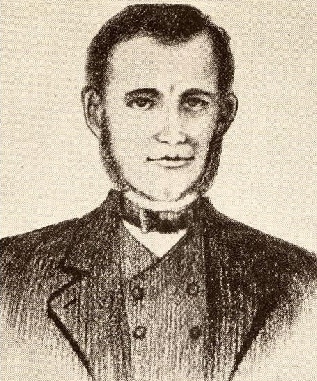
Sam Houston, Texas Secession — and Robert E. Lee
No secession ball will mark the day. Nor, it appears, are any other commemorative events planned by Texas, which would rather boast of its time as an independent country. But 150 years ago today, shortly after 11 a.m. on Feb. 1, 1861, a state convention voted overwhelmingly to secede from the Union.
In Austin, on the second floor of the old Texas statehouse just south of the current Capitol building (near the present-day Alamo and Texas Rangers monuments), cheering delegates to the special convention approved a short document declaring that the federal government was becoming "a weapon with which to strike down the interests and prosperity of the people of Texas and her Sister slaveholding States." Texas, they stated, was henceforth a "separate Sovereign state ... absolved from all allegiance to the United States." (An even more explicit "declaration of causes" followed a day later; it's well worth a read.)
For one aging veteran in the hall, this was the blackest of days. Sam Houston, the 67-year-old governor of Texas (who had twice served as president of the Republic of Texas), had for years almost single-handedly kept secessionist sentiment in the state at bay, despite being a slaveholder himself. Nearly three decades earlier, Houston had fought for Texan independence from Mexico and guided the fledgling Republic into the Union. He did not want to lose his life's work. "Mark me, the day that produces a dissolution of this [Union] will be written in the blood of humanity," Houston, then a U.S. senator, told Congress in 1854 as he defied Southern predilections to vote against the Kansas-Nebraska Act.
Of himself, he had said: "I wish no prouder epitaph to mark the board or slab that may lie on my tomb than this: 'He loved his country, he was a patriot; he was devoted to the Union.'"
As secessionist fever swept Texas, Houston was denounced as a "traitor-knave" for his Unionist views. Always, though, when the grand old man — who still hobbled from a wound sustained at San Jacinto in 1836 — took the stage, he had been able to quell his rivals. But as the year 1860 drew to a close, with Abraham Lincoln's election causing South Carolina to secede and other states to teeter on the brink, Houston, despite being governor, could no longer hold back the tide.
He tried. When secessionists began clamoring for a special legislative session in anticipation of secession, Houston stalled. Soon, however, a secession convention at the end of January 1861 appeared inevitable. Houston convened a special session of the Legislature just before the convention, hoping that he could somehow persuade lawmakers to rein in the proceedings.
It was not to be. The delegates — chosen in a hastily organized election in early January — convened in Austin on Jan. 28, 1861, and quickly penned a document that would sever Texas' ties to the federal government. Houston was invited to the roll call on Feb. 1. He sat "grim and motionless," writes his biographer M.K. Wisehart. One man called him a traitor to his face, though Houston's allies swiftly demanded (and received) an apology. The delegates approved the secession ordinance, 166-8.
The governor won a few concessions, however. He had said he would swallow secession if the people ratified it — so it was put to a vote on Feb. 23, 1861, and the people affirmed it, 44,317 to 13,020. Houston tried to argue that Texas voters had merely approved secession, rather than latching onto the Confederacy. This was technically true, but the governor, who preferred that Texas should return to its old status as an independent country, had lost his sway. In March, Texas became the last state to join the Confederacy in the "first wave," before hostilities broke out at Fort Sumter.
A defiant Houston would swear no oath to the Confederacy, and he was finished as governor. "Fellow citizens, in the name of your rights and liberties, which I believe have been trampled upon, I refuse to take this oath," he declared on March 16, 1861. "In the name of the nationality of Texas, I refuse to take this oath. …" Nor would he live to see the end of the war he tried so hard to avert; he died in 1863, a year after the Battle of Shiloh, in which his son, Sam Jr., a Confederate soldier, was wounded and held prisoner for months. Texas, in fact, would become the site of the last battle of the Civil War, in May 1865. It was also the last rebel state readmitted to the Union, on March 30, 1870, subject to several conditions.
There is another peculiar post-script to the secessionist drama of 1861.
Oddly enough, one Robert E. Lee was living in Texas at that time. Lee had been stationed in Texas on and off for several years, commanding the Second United States Cavalry in frontier skirmishes against Comanches and Mexicans. He didn't seem too fond of the frontier life; he wrote to his wife of living of a "desert of dullness."
With war approaching, Lee received orders summoning him back to Washington, so he departed Fort Mason, in Mason County, on Feb. 13, 1861, for the journey east. But in San Antonio, Lee was waylaid. A federal general from Georgia, who had taken over Lee's Texas responsibilities, had just cheerfully surrendered his men and supplies to Texas rebels who had ridden out to San Antonio (Sam Houston had dispatched the Texas Rangers to try to prevent this, but they did not arrive in time). So Lee, as a federal army officer, was potentially a prisoner in a state (or country) that was preparing for war with the federal government.
Lee donned civilian garb, reminded the Texans he was a Virginian, and was ultimately allowed to proceed (though he was apparently quite provoked by the Texans, who tried unsuccessfully to get him to declare allegiance to the South then and there). He got back to his home in Arlington on March 1 — and little more than a month later, took a command in the Confederate army.