About WDFloyd

Dave Floyd is an attorney, real estate broker, real estate investor, and trivia host in Austin, Texas. He works with the Foskitt Law Office and is an owner of Floyd Real Estate. He lives in the Zilker Neighborhood, and is a graduate of the University of Texas at Austin and the Washington & Lee University School of Law.

Monday, February 21, 2011

Texas Politics: Regarding Budget Cuts, Poll Shows Mixed Signals from Texans

UT/Texas Tribune Poll: Mixed Signals on Budget Cuts


  • By a margin of more than 2 to 1, Texas voters believe that lawmakers should solve the state's massive shortfall by cutting the budget, according to the latest University of Texas/Texas Tribune poll, but their enthusiasm dissipates when asked if they support specific cuts.
    "We really want to slash the budget, but not anything in it," says pollster Daron Shaw, a professor of government at UT.
    On a sliding scale of 0-10, poll respondents were asked whether they would prefer to balance the state's next budget through budget cuts, by raising revenues, or something in between. Only 4 percent proposed doing it all with new revenue, while 17 percent would do it all with budget cuts. Another 22 percent landed right in the middle. But the rest leaned more toward cuts than toward raising new money for the state government.
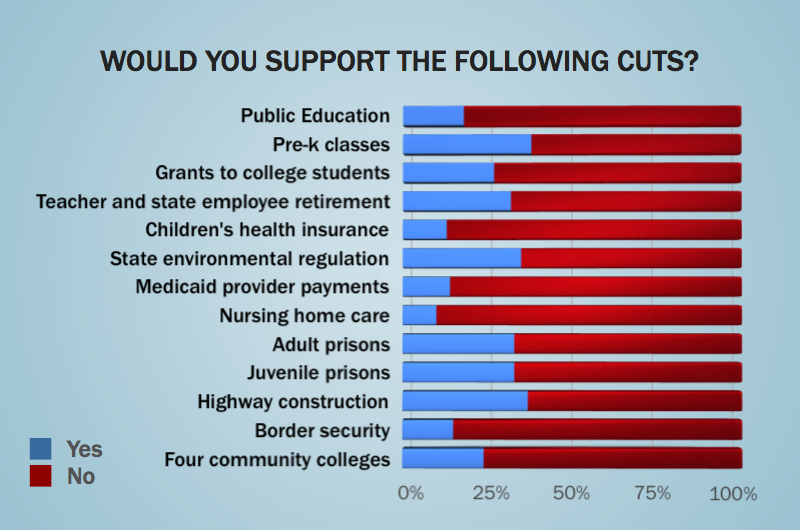
    Still, when asked specifically what should be cut, voters were more divided. Given a list of things that could be cut to balance the budget and asked to check each that they'd consider, the voters were protective of state programs, and overwhelmingly so. They oppose cuts to public education, 82 percent; pre-kindergarten, 62 percent; state grants to college students, 73 percent; state contributions to teacher and state employee retirement programs, 69 percent; the Children's Health Insurance Program, 87 percent; to state environmental regulation that could be picked up by the federal government, 65 percent; cuts to Medicaid providers like doctors and hospitals, 86 percent; state funding for nursing home care, 90 percent; prisons for adults or for juveniles, both 67 percent; new highway construction, 63 percent; border security, 85 percent; or for closing four community colleges, 77 percent.

    Many of the items on that list are among the prime cuts made in proposed budgets from the House, the Senate and the governor.
    "Frankly, if you're assuming the results of the last election mean you should cut and that people meant government should completely go away, you're overreaching," says pollster Jim Henson, who teaches government and runs the Texas Politics Project at UT.
    Republicans and independents were more likely than Democrats to prefer spending cuts over revenue increases. Men were more likely than women, and whites more likely than blacks and Hispanics, to lean toward cuts. Those trends were evident in the questions about specific cuts, too, but with only a few exceptions, each of those subgroups was against the specific cuts in the poll. Those who identified themselves as "strong Republicans" and "lean Republican" support cuts to pre-K classes, as do voters over 65. Republican-leaning independents would narrowly support cuts in public employee retirement plans. But the overwhelming result is the same in all groups: Support for specific cuts is dramatically lower than the general support for a smaller state government.
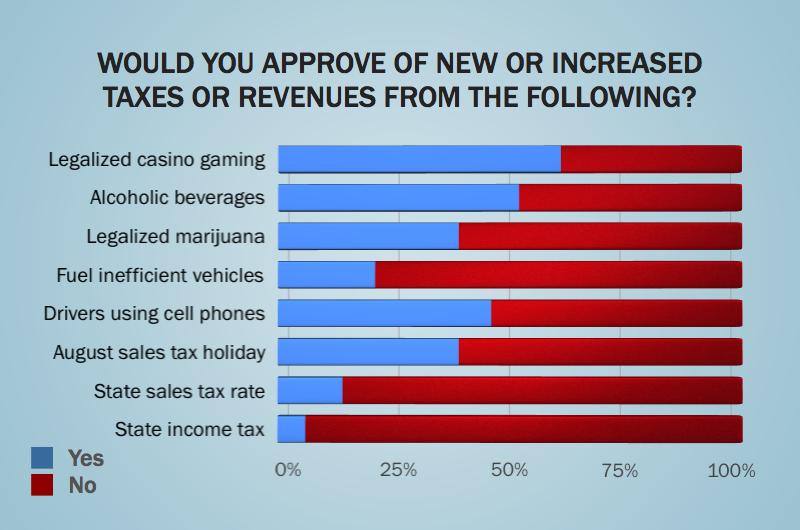
    The poll explored some ways to raise money for state government and with a couple of exceptions, they're not popular, either. A majority — 61 percent — would support legalizing and taxing casinos. A smaller majority — 52 percent — would support higher taxes on alcoholic beverages.

    Then there's the list of things they don't like, along with the percentages of the opposition: surcharges on gas-guzzlers, 80 percent; banning cell phone use by drivers and fining the violators, 54 percent; legalizing and taxing marijuana, 61 percent; eliminating August sales tax holidays if the outlook doesn't improve, 61 percent; increasing state sales tax rates, 86 percent; or imposing a state income tax, 94 percent.
    The state will have $9.4 billion available in its Rainy Day Fund, according to Comptroller Susan Combs. Only 9 percent would use all of that money, and 24 percent would use none of it. Most — 55 percent — would spend some, but not all of it to avoid budget cuts.
    "If you're a purely craven and political weasel, you have to pay some lip service to cutting and then take a strong look at gambling and other options," Shaw says. "What it says, basically, is that if you are interested in cutting, you have to either ignore or lead on public opinion.
    "If you want [to shrink government], you have to make it about cutting the deficit. If you don't want it, you talk about specific programs," he says.
    Both pollsters say state leaders will have to pick a way through the public's split opinion — cut government but don't cut anything dear — to stay out of trouble in the next political season. Henson says the numbers don't offer a road map to anyone looking for a way out of the state's budget swamp.
    "It's no surprise that people talk about wanting a better outcome without having a well-developed idea about how to get there," he says. "It's interesting to see the legislators and the voters both in a state of muddling."
    This latest University of Texas/Texas Tribune poll is an internet survey of 800 registered voters conducted Feb. 11-17 and has a margin of error of +/- 3.46 percent.
    This article originally appeared in The Texas Tribune at http://trib.it/gVAZf7.

  • Friday, February 18, 2011

    Testing

    Testing with J6FK63DZEP5H

    Coming Soon: DIVE Bar


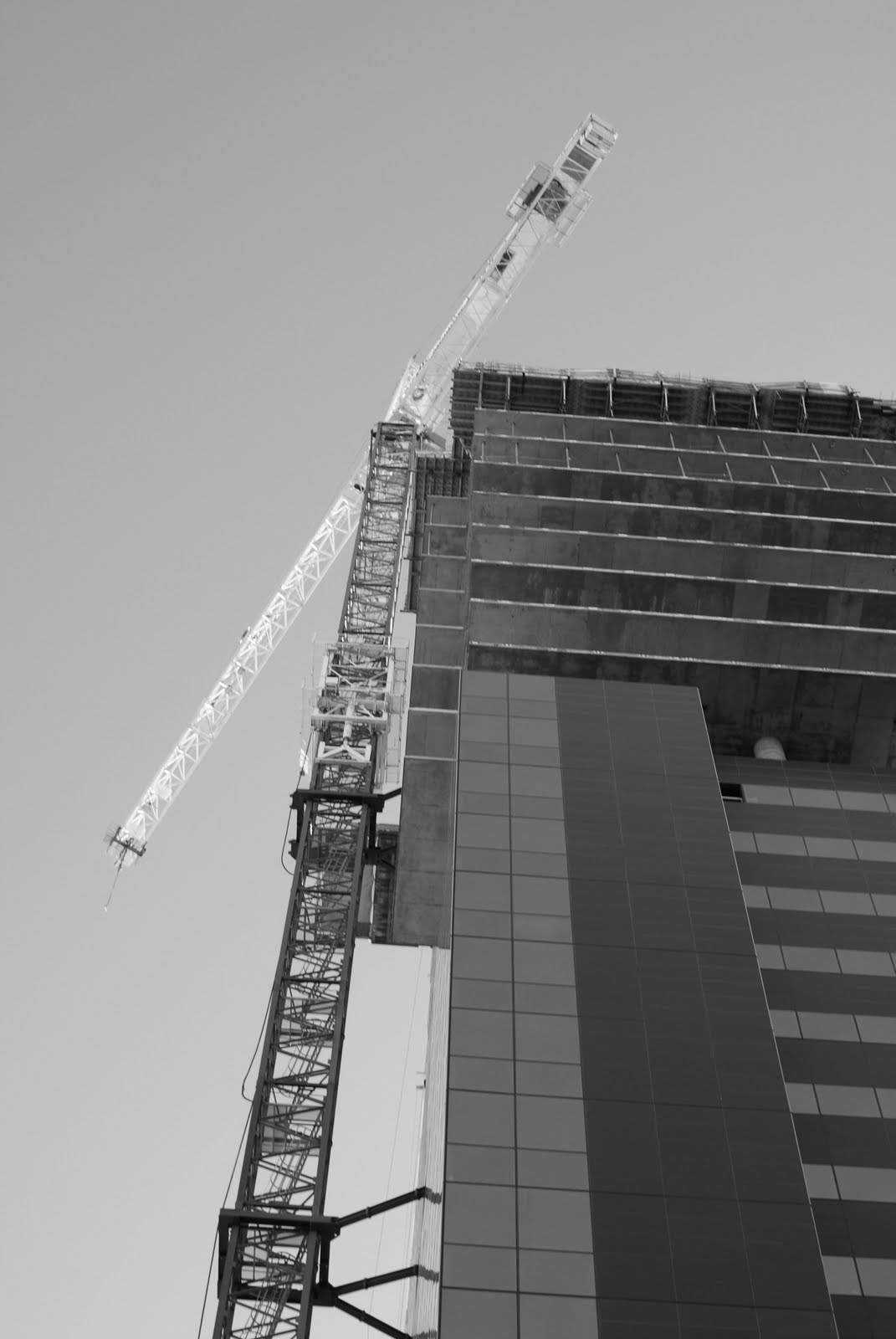
    [photo (by WDFloyd): NE Corner of Guadalupe and 17th, the Future Home of DIVE Bar]

    It's mid-February, and I'm excited about a lot of things. First of all, I can't wait for the Catalyst 8 Mad Hatter Tea Party on 2/22. Second (and only because of the chronology), I can't wait for the opening of DIVE Bar at Guadalupe and 17th (across from the Dog & Duck, right next to the D. Berman Gallery.

    DIVE will feature a full bar in a neighborly setting. Located near the Capitol Complex, the Texas Attorney General's office, and the Wells Fargo Tower, DIVE will a great place to walk for cocktails. A couple of my good friends will be taking some shifts behind the bar, and I hear rumors of some pretty awesome entertainment which is currently being lined up. And, DIVE is owned by some good folks who do a lot of good things for the community.

    Last time I checked, DIVE will be opening right around SXSW. I plan to be there, giddy about SXSW Interactive.

    Thursday, February 17, 2011

    Drinks: Gin With Old School Tonic


    [photo (by WDFloyd): my stock cocktail photo, as Haddington's was too dark for my iPhone camera]

    by WDFloyd


    Last night, I was on the loose after the Austin Habitat Young Professionals' Build the Love fundraiser. I drove a couple of friends (who were highly amused that I drive a Passat as opposed to 4x4 truck) over to the West 6th area for a pit stop at Haddington's.

    Although this was my first stop in Haddington's, I'd already heard many good things about the place from reputable sources (e.g., one of my company's employees is a foodie and he loves Haddington's). I didn't have time to eat, but I did have time for a cocktail. And that's when I discovered the Haddington's house version of the gin & tonic.

    What makes Haddington's G&T special is that the tonic water is mixed on site and it includes a healthy dose of the traditional ingredient quinine. The gin & tonic has an interesting history which combines the twin needs of 19th century British colonialists to: (1) prevent malaria, and (2) get hammered. Quinine was an anti-malaria drug administered via tonic water, and the concoction was quite bitter. Enter gin, once about as reputable as crack cocaine but refined and then rebooted as "medicinal" thanks to its infusion of tasty "botanicals" with good old fashioned booze. Moreover, sweet and delicious gin (plus a lime, of course) counteracted the unpleasant bitterness of 19th century tonic water. Plus, I'm sure the alcohol helped the British cope with the stress of living in constant fear of malaria, cobras, tigers, angry colonials, and so forth.

    Since quinine's flavor is kind of overpoweringly bitter, and because in the United States we aren't very concerned about malaria, most brands of tonic water contain only a token amount of the medicinal ingredient. Thus, you can see the novelty of Haddington's gin & tonic, which is about as close to the original cocktail as one can get while on West 6th. I recommend trying a Haddington's gin & tonic. It is very different from what I've always enjoyed (and yes, a lot more bitter and somewhat more salty). I liked it, although I will say that the intense flavor required some rather slow sipping. If you are trying to power drink to forget your personal problems, stick to the Jager bombs and so forth. But, if you're in the mood for some tasty and interesting cocktails, swing by Haddington's next time you are on West 6th.

    Wednesday, February 16, 2011

    Photos: I've Put a Few Up


    [photo (by Sara): me in front of Elvis' jet, The Lisa Marie]

    Since buying the bikes, I've been doing a fair amount of riding and not much photography. Well, that and I've been busy with planning the Catalyst 8 Mad Hatter Tea Party and working on strategic/tactical/operations plans for Prism Risk Management (but unfortunately, not much on the Prism Risk Management blog). And, I read a lot of legislation these days.

    However, I totally love photography and thus I finally made some time to add a few shots to the wdfloyd Flickr page (you can access it through the Flickr widget on this blog's sidebar). Mostly, it's more stuff from my trips to Marfa, the coast, and then my road trip (with the gf) from Illinois which included a fantastic layover at Graceland. I won't say any of this is my best stuff, but I think a lot of the shots are entertaining, somewhat interesting, and/or representative of the subject matter.

    Meta-info:

    If you are curious about my camera equipment: most of the shots posted on this blog are done with my Nikon D90. The cheap Nikon 18-55mm f3.5-5.6G AF-S VR II zoom lens is my workhorse, although I do own some swankier stuff.

    Thursday, February 10, 2011

    Events: HYP Build the Love


    I'd write something original, but the e-mail I received from Austin Habitat Young Professionals says everything which needs to be said:

    Featuring a delicious menu of Moonshine's favorite dishes, a great selection of wines, and live music by Lucas Cook, Build the Love is the tastiest - and easiest - way to make a difference!

    February 16, 2011 -- 6:00pm to 9:00pm
    Moonshine - 303 Red River Street
    $25 Members/$35 Non-members
    Buy Tickets Now

    Each year, HYP commits to raising funds and volunteering on-site to build a home with Austin Habitat for Humanity. Thanks to HYP's efforts in 2009, another family is now living in a safe, secure neighborhood in a home they can afford. It was an awesome feeling to see how thankful and gracious the Arellano family was when we dedicated their home! You should have seen the smiles that day!

    This year mark’s HYP’s 5th anniversary and we are striving to raise more than ever before. We've set a goal of $100,000 in 2011. This will fully fund one Habitat house and provide Austin Habitat for Humanity with some additional funds to put towards another home.

    Virtually all funds raised by HYP are generated through events like Build the Love, and we couldn't do it without you!

    Sunday, February 6, 2011

    Services: The Atypical Mechanic


    [photo (by WDFloyd's iPhone): Jeremy, The Atypical Mechanic, at work on my car]


    Let's say the Check Engine light comes on in your car. You'd like to get this looked at and fixed. You'd also like it fixed by a good mechanic who changes reasonable prices and comes to your home or office. Wishful thinking? Not at all. I submit to you: The Atypical Mechanic.

    I've known Jeremy, owner of The Atypical Mechanic, for quite a while. I already knew he was a good guy, just from personal experience and from watching him work above and beyond the call of duty as the Volunteer Chair for Austin Habitat Young Professionals. Thus, when my Check Engine light turned on and my car began to exhibit a noticeably rough idle, I contacted The Atypical Mechanic immediately.

    Jeremy did indeed come to my building, check out my car, and do some research into what turned out to be kind of an obscure problem. He then returned and replaced the part while I took a break from working in my home office. And, he did all of this on site for less dinero than I anticipated. The result: my car is back to normal and I have spare cash to blow on bike parts. And, as I bonus, he let me watch him work on the car and he answered all of my questions about the engine.

    If you're looking for quality auto mechanic services done at your home or office for a reasonable price, then contact: The Atypical Mechanic

    Friday, February 4, 2011

    Events: The Return of the Catalyst 8 Mad Hatter Tea Party

    Brace yourself for the return of Catalyst 8's Mad Hatter Tea Party. On February 22, 2011 from 7:30 to 10:30p, we will again turn the Allan House into an Austin version of "Wonderland." By that I mean the good kind of wonderland, which will feature signature drinks to consume while you enjoy entertainment throughout the event from cabaret artists Starlite and Shi Feticcio (with her twin sister Ze-Boi making a special guest appearance)... as opposed to the bad kind of Wonderland, which features a homicidal, moody monarch and a rabbit with glandular issues. But don't worry, at our event there will also be models dressed up as Alice in Wonderland characters. They will just be better looking and nicer than the characters described in the Lewis Carroll book.


    In addition to our excellent line up of cabaret performers, Austin’s own Dub Academy will DJ the event. Drinks will be provided by our friends from Maker’s Mark, Tito’s Vodka, and Independence Brewery. And, a special thanks to the support from our sponsors Moreland Properties and Hay Compere, PLLC, as well as our media sponsor Tribeza.

    Tickets to the Mad Hatter Tea Party are free to Catalyst 8 members, and $35 for non-members. Catalyst Members must RSPV in advance in order to receive said free admission. Funds raised by this event go to support Catalyst 8's Boost Program.

    ABOUT CATALYST 8

    The mission of Catalyst 8 is to spread awareness about the Long Center for the Performing Arts and arts in Austin, to provide opportunities for social and professional access and involvement, and to develop leaders for our community. Funds raised through membership and events fund Catalyst 8’s Boost Program. which provides rental subsidies to Austin-based emerging and underserved arts groups. Catalyst 8’s goal is to expand the diversity of programming and audiences at The Long Center for the Performing Arts while giving area artists a needed "boost" in exposure.

    Texas Legislature: "Complete Streets" Bill is Filed


    Lawmakers File "Complete Streets" Bill


  • Lawmakers today filed a bill they hope will help drivers, cyclists and pedestrians safely share the roads.

    State Rep. Linda Harper-Brown, R-Irving, and Sen. Rodney Ellis, D-Houston, filed so-called “Complete Streets” legislation, which would require the Texas Department of Transportation to “recognize that bicycle, pedestrian, and transit modes are integral elements of the transportation system,” and develop safer streets for people to walk, bike or drive.


    "If more Texans have the option to use alternative forms of transportation, we could be healthier and safer, our streets could be less congested and cleaner, and our local and regional economies would benefit from increased activity," Ellis said in a statement.


    Making safe routes for children to walk or bike to school could help reduce childhood obesity, say Marcia G. Ory and Deanna Hoelscher, leaders of the Texas Childhood Obesity Prevention Policy Evaluation. Only 13 percent of children walked or biked to school in 2009, compared to 42 percent who did 40 years ago. Their research found students were more likely to walk or bike to school if streets were designed to protect them and parents were confident in their safety.


    “We were in an area doing these environmental audits, and the next week an eighth-grader had an accident, a critical injury in the street,” said Ory. “That’s because there’s a crosswalk, but the cars don’t stop and she got hit.”


    Designating distinct spaces for cyclists, pedestrians and cars creates safe environments for everyone on the road, says Gil Peñalosa, an expert on urban transportation and executive director of 8-80 Cities.


    For most people, Peñalosa says, the decision about whether to bike depends on how safe they feel.


    “Cycling is not just something men 20 to 50 in spandex will do,” said Peñalosa.


    This article originally appeared in The Texas Tribune at http://trib.it/gPBuCf.


    Wednesday, February 2, 2011

    Cycling: Map My Ride


    [photo (by WDFloyd): my Gary Fisher 29er hardtail, parked along Shoal Creek]

    From the age of 8 until about the age of 16, I biked a lot. Then I got a car. Mysteriously, the biking stopped. Then, in November, I decided I should work out more. I bought a Gary Fisher (or more accurately, Gary Fisher collection from Trek) hardtail mountain bike from the good folks at the Bicycle Sport Shop on South Lamar. Featuring 29" tires and Fisher's Genesis 2 ("G2") aluminum frame, this bike seemed to handle well and be capable of rolling over all sorts of obstacles. Biking resumed.

    My Fisher mountain bike is a lot of fun to ride both on and off road. However, I recently found myself riding on paved surfaces quite a lot. A road bike seemed liked a good idea. Thus, I bought a Trek from the good folks at Mellow Johnny's. And I love it.

    I rode it around downtown a few times and around Barton Hills. Then, on Monday night, after going to a reception adjacent to the TASA Midwinter Conference, I took the Trek for a night ride. It ended up being very long. And that is when I became curious about distance, which led to the discovery of Map My Ride.

    Map My Ride classic
    allows you to set points on a Google street map with simple mouse clicks. You just drop and drop your route onto the screen, and instantly you know how far your ride was. While a cycle computer can tell you how far you've gone, this application does more by letting you map out prospective rides to find one which fits into the distance and area of town you want. The program will even figure out elevation. You can then save these routes for future reference.

    Anyway, while the "classic" version is cool, and the new (Beta) version looks like it has a lot more tools for recording your progress with workouts, rides, training programs, and things of that nature. If you like to share, there are forums. Moreover, there is a mobile interface as well, so you can work with Map My Ride while you're out in the wild.

    Check out either version if you're curious about distances of prospective routes, keeping logs of your rides, or you just tend to be obsessive about such things.

    Tuesday, February 1, 2011

    Events: Raise the Bar Happy Hour


    [photo (by WDFloyd): Habitat for Humanity House Build at Devonshire Block, Nov. 2009]


    On February 24 the Austin Bar Association will be hosting their Raise the Bar Happy Hour at Roial from 5:30-8:30p. This event will raise funds for the Austin Bar Association's Legal Build for Habitat for Humanity. Legal Build has made a lot of progress this year, and they had a very successful fundraising drive at this year's Austin Bar Gala, but they still need funds to cover the cost of building the Legal Build sponsored house. So, come down to Roial, meet some fun lawyers, and help make the dream of home ownership a reality for the recipient of the Austin Bar's Legal Build Habitat for Humanity house.

    Texas History: Secession and Robert E. Lee


    Sam Houston, Texas Secession — and Robert E. Lee


  • No secession ball will mark the day. Nor, it appears, are any other commemorative events planned by Texas, which would rather boast of its time as an independent country. But 150 years ago today, shortly after 11 a.m. on Feb. 1, 1861, a state convention voted overwhelmingly to secede from the Union.


    In Austin, on the second floor of the old Texas statehouse just south of the current Capitol building (near the present-day Alamo and Texas Rangers monuments), cheering delegates to the special convention approved a short document declaring that the federal government was becoming "a weapon with which to strike down the interests and prosperity of the people of Texas and her Sister slaveholding States." Texas, they stated, was henceforth a "separate Sovereign state ... absolved from all allegiance to the United States." (An even more explicit "declaration of causes" followed a day later; it's well worth a read.)


    For one aging veteran in the hall, this was the blackest of days. Sam Houston, the 67-year-old governor of Texas (who had twice served as president of the Republic of Texas), had for years almost single-handedly kept secessionist sentiment in the state at bay, despite being a slaveholder himself. Nearly three decades earlier, Houston had fought for Texan independence from Mexico and guided the fledgling Republic into the Union. He did not want to lose his life's work. "Mark me, the day that produces a dissolution of this [Union] will be written in the blood of humanity," Houston, then a U.S. senator, told Congress in 1854 as he defied Southern predilections to vote against the Kansas-Nebraska Act.


    Of himself, he had said: "I wish no prouder epitaph to mark the board or slab that may lie on my tomb than this: 'He loved his country, he was a patriot; he was devoted to the Union.'"


    As secessionist fever swept Texas, Houston was denounced as a "traitor-knave" for his Unionist views. Always, though, when the grand old man — who still hobbled from a wound sustained at San Jacinto in 1836 — took the stage, he had been able to quell his rivals. But as the year 1860 drew to a close, with Abraham Lincoln's election causing South Carolina to secede and other states to teeter on the brink, Houston, despite being governor, could no longer hold back the tide.


    He tried. When secessionists began clamoring for a special legislative session in anticipation of secession, Houston stalled. Soon, however, a secession convention at the end of January 1861 appeared inevitable. Houston convened a special session of the Legislature just before the convention, hoping that he could somehow persuade lawmakers to rein in the proceedings.


    It was not to be. The delegates — chosen in a hastily organized election in early January — convened in Austin on Jan. 28, 1861, and quickly penned a document that would sever Texas' ties to the federal government. Houston was invited to the roll call on Feb. 1. He sat "grim and motionless," writes his biographer M.K. Wisehart. One man called him a traitor to his face, though Houston's allies swiftly demanded (and received) an apology. The delegates approved the secession ordinance, 166-8.


    The governor won a few concessions, however. He had said he would swallow secession if the people ratified it — so it was put to a vote on Feb. 23, 1861, and the people affirmed it, 44,317 to 13,020. Houston tried to argue that Texas voters had merely approved secession, rather than latching onto the Confederacy. This was technically true, but the governor, who preferred that Texas should return to its old status as an independent country, had lost his sway. In March, Texas became the last state to join the Confederacy in the "first wave," before hostilities broke out at Fort Sumter.


    A defiant Houston would swear no oath to the Confederacy, and he was finished as governor. "Fellow citizens, in the name of your rights and liberties, which I believe have been trampled upon, I refuse to take this oath," he declared on March 16, 1861. "In the name of the nationality of Texas, I refuse to take this oath. …" Nor would he live to see the end of the war he tried so hard to avert; he died in 1863, a year after the Battle of Shiloh, in which his son, Sam Jr., a Confederate soldier, was wounded and held prisoner for months. Texas, in fact, would become the site of the last battle of the Civil War, in May 1865. It was also the last rebel state readmitted to the Union, on March 30, 1870, subject to several conditions.


    There is another peculiar post-script to the secessionist drama of 1861.


    Oddly enough, one Robert E. Lee was living in Texas at that time. Lee had been stationed in Texas on and off for several years, commanding the Second United States Cavalry in frontier skirmishes against Comanches and Mexicans. He didn't seem too fond of the frontier life; he wrote to his wife of living of a "desert of dullness."


    With war approaching, Lee received orders summoning him back to Washington, so he departed Fort Mason, in Mason County, on Feb. 13, 1861, for the journey east. But in San Antonio, Lee was waylaid. A federal general from Georgia, who had taken over Lee's Texas responsibilities, had just cheerfully surrendered his men and supplies to Texas rebels who had ridden out to San Antonio (Sam Houston had dispatched the Texas Rangers to try to prevent this, but they did not arrive in time). So Lee, as a federal army officer, was potentially a prisoner in a state (or country) that was preparing for war with the federal government.


    Lee donned civilian garb, reminded the Texans he was a Virginian, and was ultimately allowed to proceed (though he was apparently quite provoked by the Texans, who tried unsuccessfully to get him to declare allegiance to the South then and there). He got back to his home in Arlington on March 1 — and little more than a month later, took a command in the Confederate army.


    This article originally appeared in The Texas Tribune at http://trib.it/hILnPe.

    Monday, January 24, 2011

    Events: KLRU Next Launch Party

    [photo by WDFloyd: the W Hotel in downtown Austin, under construction in Nov 2009]


    This Tuesday, join us for the KLRU Next Launch Party at the new W Hotel downtown. KLRU Next is the active young professionals group affiliated with Austin's public television station, KLRU. And, of course, KLRU is the parent of Austin City Limits.

    I'm a founding member of KLRU Next, and I'll be leading one of the tours of the almost completed Moody Theater, the new home of Austin City Limits. Come by for that... and, if you join KLRU Next by 7p on 1/25, then you'll be entered in a drawing to win tickets to the upcoming KLRU Opening Night Party (featuring the Steve Miller Band), which will celebrate the opening of the new Moody Theater's Austin City Limits Stage.

    Events: Catalyst 8's 2011 Preview @ La Sombra


    This Wednesday, we've got the Catalyst 8 2011 Preview at La Sombra. The good folks at La Sombra are hooking us up with some tasty South American snacks as well as happy hour prices all night long. Catalyst 8 had an amazing year in 2010, and we're planning to take it to another level in 2011. Join us we celebrate the successes of 2010 and as we discuss some great upcoming events, including: the return of the Mad Hatter Tea Party at the Allan House, a beer tasting event at Independence Brewery, a happy hour in the soon to be opened DIVE Bar, and our plans for another stellar Summer of Catalyst 8. I can't yet share what the plans are for Bash 2011, but if we do what I think we are going to do it will be a groundbreaking event for Austin.

    About Catalyst 8:

    Catalyst 8 supports the Boost Program, which provides rental subsidies to qualifying emerging and underserved performing arts groups in Austin. Said subsidies pay for all or part of the rental fees said groups are required to pay in order to use the Long Center's Rollins Theater.

    Friday, January 21, 2011

    Texas Energy: Wind Energy Transmission

    Texas OKs New Wind Power Transmission Lines

    by Kate Galbraith, The Texas Tribune
    January 21, 2011

    Texas is in the midst of a wind-power boom, and at the heart of it lies a conundrum: While plenty of ranchers are eager to host wind turbines, few want the unsightly high-voltage transmission lines needed to carry the power to distant cities running through their property.

    The lack of transmission lines — and the relatively low price of natural gas — has thwarted the ambitions of wind-power advocates to expand the use of this alternative energy source in Texas. The oilman T. Boone Pickens, for example, bet heavily on wind a couple of years ago, ordering hundreds of turbines and announcing plans to build the world’s largest wind farm in the Panhandle at a cost of up to $12 billion. He later scaled back, canceling some of the turbine orders, giving up his land lease and saying he was looking elsewhere to build.

    To encourage others, the state is moving forward on a contentious project to erect $5 billion worth of transmission wires to connect the turbines to the cities that need power. On Thursday, state regulators met in Austin and approved the route of a controversial line that will run about 140 miles through the Hill Country, one of the state’s most scenic regions.

    Construction of the line — a project of the Lower Colorado River Authority that will run from Schleicher County to a substation near Comfort — should start next year. Last year, vigorous opposition by landowners, both wealthy newcomers and old-time families, succeeded in derailing plans for another line that the state had wanted to build through the area. Instead, the existing electric infrastructure will be upgraded to carry a greater load. The Public Utility Commission, which is overseeing the process, has also canceled plans for an additional segment of the Hill Country line discussed at the meeting Thursday.

    “All Texans love their land,” Barry Smitherman, the commission chairman, said in an interview a few days ago. During the process of planning the routes for transmission lines, Smitherman said, “we didn’t please everyone, but I think with each of these we really tried to work hard to make it as acceptable as possible for the landowners.”

    Texas embarked on the transmission line project, known as Competitive Renewable Energy Zones, several years ago. The need was clear: in West Texas, home to the vast majority of the state’s wind farms, so many turbines have been built over the past decade that some must be shut down during windy periods because there are not enough wires to transport the power. Texas is the leading wind-power state by far, with nearly three times as much capacity as the next-closest state, Iowa. Once built, the new lines are expected to span more than 2,300 miles.

    The Hill Country is not the only part of Texas where resistance to new power lines has been fierce. Landowners near Palo Duro Canyon State Park in the Panhandle also put up vigorous opposition. Their arguments against one of the proposed lines prevailed, so it will be built elsewhere and not cross the dramatic canyon landscape. Nonetheless, another line could still go across the canyon. Residents of Denton County, north of Fort Worth, worry that a proposed line could cross landmarks like a park area called the Greenbelt or a Girl Scout camp.

    The utilities building the lines can take the land by eminent domain as a last resort, if they and property owners cannot agree on a price for an easement on the land. That would probably be a very unpopular move. Gov. Rick Perry, who appoints the commissioners, just declared that strengthening private property rights was a “legislative emergency” for state lawmakers to take up as soon as possible.

    Catherine Frazier, a spokeswoman for the governor, said in an e-mail that Perry “supports efforts to build the necessary transmission network” to aid wind power's development.

    “He expects utilities to use existing rights of way when possible and look at options to minimize impacts to private landowners,” Frazier said.

    The utility commission has completed its work on many of the routes, Smitherman said, and all of them should be decided this spring.

    The process of choosing routes for the various lines has been a minefield for the three commissioners. Besides landowners’ concerns, the commissioners hear testimony about endangered species habitats, airports, military bases, rivers and many other topographical or cultural features that could pose conflicts. Their task is to devise routes that will do the least damage and contain costs, which will be passed on to Texas ratepayers.

    Once all the lines are built, they will nearly double the amount of wind-energy capacity in Texas. Last year, wind supplied the Texas power grid with nearly 8 percent of its electricity. The rest of the country averages about 2 percent.

    This article originally appeared in The Texas Tribune at http://trib.it/h1WTHG.

    Wednesday, January 19, 2011

    Lucy's Retired Surfer Bar Re-opens in Joe's Old Location

    I was just down on West 6th for an early HH at J. Black's. On my way back to the car, I noticed the the Lucy's Retired Surfer Bar (which has been built in the former site of Joe's) is set to open on Friday. This is the second iteration of this bar in Austin, the former site of Lucy's now being the current site of the Chuggin' Monkey. I remember going to the Lucy's on east 6th back in college. Appropriately, the new location is being opened in the area in which I now like to hang out.

    Reckless Kelly is playing at Lucy's on Friday night.

    Cycling: Austin Bike Map


    [photo (by WDFloyd):]


    After my very long hiatus from cycling, I realized that I had virtually no idea about all of the various bike lanes and safe bike routes around Austin. Fortunately, the good folks at Mellow Johnny's are providing a download-able bike map of Austin. Route difficulty is indicated by color code and off-road trails are marked. Also marked are barriers to bicycling.

    I've been riding about half of the time on trails, such as the Barton Creek Greenbelt and the Shoal Creek Hike & Bike, and about half of the time on streets in West Austin and in the downtown area. I've used the bike map to find some good street routes and to plan out some prospective rides combining streets and trails.

    Tuesday, January 11, 2011

    HYP Global Village: Deadline Extended


    In case you wanted to apply for a slot with Austin Habitat Young Professionals' Global Village trip to Xela, Guatemala, then check out the following updates:


    1. The application deadline has been extended to 1/14; and


    2. The trip is now open to people who are not members of Austin HYP, provided that said applicants are sponsored by a member of Austin HYP.


    Prospective participants need to commit to a fund raising goal of: (1) $3000, or (2) $2250 plus a self booked flight to Guatemala.

    This is an awesome opportunity. One of my friends did a Global Village trip in 2009 and loved it. The above listed trip should provide a similarly positive experience.

    Events: Catalyst 8's 2011 Preview @ La Sombra

    Catalyst 8 is starting off 2011 with a happy hour at La Sombra from 6-8p on 1/26. We're planning to celebrate the multiple successes of 2010, as well as get everyone excited about the upcoming return of our legendary Catalyst 8 Mad Hatter Tea Party.

    Mad Hatter is on the calendar for 2/22, from 8-10:30p at the Allan House. The VIP reception begins at 7p (Catalyst 8 members will receive VIP admission). Last year's Mad Hatter party was one of our hottest events, and this year we're raising the bar with artistic burlesque performances as well as drinks sponsored by Maker's Mark and Tito's. I'll post a link to buy tickets once they are available; get yours early, as this event will sell out.

    But, back to La Sombra: I've heard great things about this place. My friend Pat recently raved about the chicharrones, a dish mostly consisting of crispy pork belly. Knowing my love of bacon, I'm sure to be all over this dish. But, more important than my love of pork products: if you're interested in learning more about Catalyst 8 and the upcoming Mad Hatter event, then be sure to join us at La Sombra on 1/26. As great as 2010 was, we've got an even more exciting agenda planned for 2011.


    About Catalyst 8:

    Catalyst 8 supports the Boost Program, which provides rental subsidies to the Long Center's Rollins Theater for qualifying emerging and underserved performing arts groups in Austin.

    Cycling: Obnoxiously Bright Lights


    [video: they don't look cool, but they appear to be obnoxious enough to get you noticed by cars]

    I recently resumed bicycling after a very, very long hiatus. It turns out that I have a habit of riding kind of late, to the point that I'm often returning to HQ as it's getting kind of dark. Enter the need for illumination. The good folks at REI steered me toward lights made by Planet Bike, and thus I bought the "Blinky Super Flash" tail light and the "Blaze" headlight. As you can see in the above video, these things light up the bike like a little emergency vehicle.

    The Planet Bike "Blinky Super Flash" tail light has 1/2 watt LEDs and claims to be visible for up to a mile. It also claims to be weather proof and to operate in flashing mode for up to 100hrs (on AAA batteries). This light slides easily on and off of a seat post mount, so it can be stored in your bag when you don't need it, yet is quickly available when the sun begins to set. This tail light retails for about $30.

    The Planet Bike "Blaze" 1 watt LED headlight is pretty bright, to the point that I can see it reflecting off of street signs a few blocks ahead. In "super flash" mode, it is annoyingly hard to miss. Moreover, it quickly mounts on your handlebars, thus making it easy to keep this thing out of sight until it's needed. I wouldn't ride around creek trails with this light as my only source of illumination, but it seems to work pretty well for alerting cars to your presence. According to the manufacturer, the "super flash" mode should run for about 20 hrs (on two AAA batteries). The light retails for about $45.

    Monday, January 10, 2011

    Texas Politics: Overview of Key Issues for 82nd Legislature

    Texas Legislature Convenes, Facing Hard Choices


    by Brandi Grissom, Reeve Hamilton, Elise Hu, Ross Ramsey, Emily Ramshaw, Morgan Smith, Matt Stiles, Julian Aguilar and Kate Galbraith, The Texas Tribune
    January 9, 2011


    The 82nd Texas Legislature convenes in Austin this week, and while it’s not as much fun as the circus — usually — it’s more important and does have its share of comedy and drama.

    The subject matter is practically operatic: in the 140 days of their regular session, lawmakers must face down a multibillion-dollar shortfall, having made blanket promises not to raise taxes. They need to draw redistricting maps for seats in Congress, the Legislature and the State Board of Education — their most partisan enterprise of the decade.

    Expect a heated word or two over immigration legislation and border security, threats of major cuts to education and health and human services, and continuing struggles to keep up with the state’s transportation and criminal-justice concerns. Here’s a look at some key issues coming up while the Legislature is in town.

    Budget

    The bane of everyone who feared story problems in math class, the budget is the central policy blueprint for the state government. And it’s deeply out of whack, with the state committed to more programs than the Legislature can finance. The size of that shortfall is estimated at $15 billion to $28 billion; the real number will be known Monday when Comptroller Susan Combs issues her revenue estimate and lawmakers unveil their starting budget proposal.

    The numbers are stark: cutting everything except education and health and human services — everything — would trim a fraction of the shortfall. Local school districts could be forced to raise property taxes to cover costs if the state makes deep cuts in education; municipalities might also be able to reduce cuts in services and staff by raising their own local property taxes.

    Lawmakers have just a few options: raise taxes, find other revenue, use the Rainy Day Fund (expected to be at least $8 billion), cut spending, shift costs to local governments or to the private sector, or use financial tricks.

    Most of the state’s officeholders campaigned on promises not to raise taxes. Raising fees for various licenses and other state services is possible, but iffy. There’s talk of legalizing gambling to increase state income.

    Using the Rainy Day Fund requires the approval of two-thirds of the Legislature. Financial tricks — like delaying payments until the next budget — are good for about $3 billion. Some state leaders want to preserve some of the state’s savings in case the budget after this one is grim, too.

    WHO TO WATCH: Steve Ogden, chairman of the Senate Finance Committee, and Jim Pitts, chairman of the House Appropriations Committee, the head writers of the state’s spending plan. — ROSS RAMSEY

    Federalism/Tea Party

    To this point, most talk about states’ rights has been just that — talk. But Texas is pushing back against the federal government in substantive ways, too: There’s legal action under way over environmental regulation (whether the Environmental Protection Agency or the Texas Commission on Environmental Quality should have supremacy here).

    Lawmakers are talking seriously about backing out of the federal Medicaid program. Some want the federal government to give states more leeway with programs financed in part by the federal government. Texas and other states have talked about petitioning to change the 14th Amendment’s provision of automatic citizenship for babies born in the United States to parents who aren’t citizens.

    The governor has been promoting his book, Fed Up!, focused on what he sees as an overreaching federal government, and he will be sworn in for a new term on Jan. 18, presumably to put some of his words into action.

    This is also the Tea Party’s first legislative session, and the combination of people it has helped elect and its ability to spur the people inside the Capitol with phone calls and letters and social media is about to be tested.

    WHO TO WATCH: Rep. Wayne Christian, R-Center, and head of the Texas Conservative Coalition; and Sen. Dan Patrick, R-Houston, founder of the new legislative Tea Party Caucus. — ROSS RAMSEY

    Speaker’s Race

    The 2011 session’s first order of business is the selection of House speaker, arguably the most powerful political post in Texas. Joe Straus of San Antonio, the Republican incumbent, is trying to keep his job amid challenges from outside grass-roots groups and socially conservative Republicans who take issue with his selection of some Democrats as committee chairmen last session, as well as his past support of groups favoring abortion rights.

    His challengers smell opportunity: the election of dozens of freshmen — many of them further to the right than their predecessors — potentially gives Straus’ opponents new allies.

    Warren Chisum, Republican of Pampa and a conservative, and Ken Paxton, R-McKinney, also want the job. Paxton has promised to use the new Republican supermajority in the House to “honestly advance conservative principles and not simply protect the status quo.” He has won the support of the Young Conservatives of Texas, the Republican Liberty Caucus and Dick Armey, the former majority leader of the U.S. House and a highly visible Tea Party booster.

    Chisum’s candidacy isn’t generating much excitement. Beverly Woolley, R-Houston, who led the powerful Calendars Committee under Straus’ immediate predecessor, Tom Craddick, took an important public stand in this largely insider struggle when she threw her support to Straus in December. It was a signal that Straus’ challengers probably won’t win the support of conservative veteran members. But politics being unpredictable, Straus won’t be on solid ground until after Tuesday’s floor vote.

    WHO TO WATCH: Freshman members. A handful of new lawmakers have thrown their support behind Straus’ challengers. They’ll either gain clout or give it up — depending on whether they’ve made the right bet. — ELISE HU

    Immigration

    Rep. Debbie Riddle, a conservative Republican from Tomball, did not wait long after the midterm elections to file immigration-related legislation. Riddle camped out in the Capitol for 36 hours to be the first to file a bill that would stop the flow of state money to any local government that provided “sanctuary” — i.e., a city that does not allow its police officers to enforce federal immigration laws — to illegal immigrants.

    Riddle told reporters that her willingness to spend the night in the Capitol showed she had “tenacity and fire in the belly” on the issue.

    Many of her colleagues share Riddle’s fervor. Several followed suit and filed bills — more than 40 — that, if passed, would significantly increase the state’s involvement with immigration enforcement. The proposed legislation would, among other things, prohibit any state agency from printing signs or documents in any language other than English, and require the police to ask people stopped without proper ID if they are in the country legally.

    Last week, a coalition of civil rights groups, business leaders and law enforcement warned that the proposed legislation would create an antibusiness climate in Texas and divert strained law enforcement resources.

    Whether the new measures, if passed, would survive legal scrutiny is another question. Arizona’s immigration legislation is tied up in federal court, which has temporarily halted enforcement of some of its major provisions.

    WHO TO WATCH: The always-colorful Riddle, of course. — JULIÁN AGUILAR

    Redistricting

    Texas picks up four seats, for a total of 36, in the U.S. House of Representatives, thanks to its population growth relative to the other states, but determining the boundaries of the new districts won’t be easy. Members of Congress and their staff members will be spending lots of time in Austin.

    Expect cajoling, jawboning, arm-twisting — whatever it takes (including the occasional lavish display of flattery) as lawmakers seek to protect their own seats and damage their opponents’. The new districts go where the people are — each must contain about 700,000 people — so it’s likely that the Dallas and Houston suburbs will gain a seat each, and the Rio Grande Valley at least one.

    State lawmakers must also redraw their own districts (150 in the House and 31 in the Senate), which must contain equal populations and be drawn with minority populations in mind. Though the Republicans have a supermajority in the House, it will still be tough for them to draw enough safe GOP districts to protect all of their members from competitive elections in 2012. But they could also try to dilute Democrats’ strength by creating more swing districts.

    State lawmakers must approve the maps, as with any other legislation. If they can’t agree on their own seats, the five-member Legislative Redistricting Board, composed of the lieutenant governor and other statewide elected officials, will decide. It’s possible that a special session in the summer will be required to finish drawing congressional seats. Then come the legal challenges.

    WHO TO WATCH: Attorney General Greg Abbott, who will have to defend the maps in any court challenges. — MATT STILES

    Criminal Justice

    Criminal-justice advocates, both liberal and conservative, agree that the biggest cost savings would come from shuttering some of the facilities that house adult and juvenile offenders. But it’s not an easy proposition to accomplish.

    The Texas Youth Commission has said the only way it could slash its budget enough is to close two more facilities beyond the five it has closed since 2007. There were more than 900 empty beds in its 10 facilities in October. The commission estimates that each facility it closes would mean 230 lost jobs. In some small towns that have youth prisons, that would be a major economic blow that could create major political fallout.

    As for adult prisons, Texas has never closed one. The prisoner population, however, dropped by more than 1,000 from the 2008 fiscal year to the 2009 one. Still, the department said it needed all of the bed space it had.

    Of course, the keys to keeping adults and juveniles alike out of prison in the first place, advocates of reform say, are the changes Texas made in specialty programs to provide more treatment for addicts and mentally ill offenders. Lawmakers, they say, should resist cutting those programs.

    Lawmakers will also have to deal with the continuing problem of wrongful convictions and the need to debate over the use of faulty evidence.

    WHO TO WATCH: Scott Henson, a very knowledgeable blogger, who writes about all things criminal justice at gritsforbreakfast.blogspot.com.— BRANDI GRISSOM

    Health and Social Services

    Expect ample political bluster — and devastating cuts. The Republican majority will continue to attack the federal health care overhaul and do everything legislatively it can to resist it.

    Lawmakers will also file bills and resolutions seeking federal waivers to redesign how Medicaid is administered, or they could try to drop out of the program. At an annual cost to the state of $10 billion, Medicaid is the single biggest health-related item on the budget.

    At the very least, legislators will most likely take aim at the rates at which Medicaid health care providers are reimbursed and expand Medicaid managed-care into the Rio Grande Valley and rural Texas.

    Other anticipated legislation? An effort to lift Texas’ ban on hospitals directly employing doctors, and a move to expand the scope of practice for nurse practitioners.

    In social services, expect cuts in community-based care for people with disabilities — the state’s big institutional care facilities are largely protected under a federal Justice Department settlement. Cutbacks in community-based care for the elderly are also possible. A redesign of the state’s foster-care system is in the works, but lawmakers will be hard-pressed to approve anything that requires more money.

    WHO TO WATCH: Tom Suehs, commissioner of health and human services, is trusted on both sides of the aisle and is a straight-shooter on budget cuts and Medicaid’s merits and shortcomings. — EMILY RAMSHAW

    Education

    In a session in which any new policy proposal with a price tag is probably dead on arrival, the most significant changes in public education could come in existing programs. To ease the burden of cuts in financing, lawmakers could relax state rules and regulations that create costs that local school districts must bear on their own or with limited help from the state.

    The most controversial proposal? Removing the requirement of a 22-to-1 student-to-teacher ratio in kindergarten through fourth grade. Legislators have also promised a new school finance bill overhauling the current long-contested mechanism.

    Colleges and universities are particularly vulnerable. Last year, when the state reduced the current biennium budget by 5 percent, more than 40 percent of the cuts came out of higher education. Deeper cuts loom, but even as the money disappears, institutions are under pressure to improve graduation rates.

    Policy makers will consider tying state money to graduation rates instead of enrollment in order to create greater incentives for improvement. They could also raise eligibility standards for the state’s largest financial aid program, which could also be slashed.

    WHO TO WATCH: The chair of the appropriations subcommittee on education. For now, that’s Scott Hochberg, D-Houston, but this is a leadership position Republicans could grab. — REEVE HAMILTON and MORGAN SMITH

    Energy

    In the 2009 session, dozens of bills to foster the use of solar power died. Some are being introduced again this year, and they’re a priority of environmentalists.

    Pro-solar action could take one of two forms: a mandate for electric companies to utilize renewable energy sources other than wind (which got its start from a mandate and has thrived) or a rebate program, specifically for solar, intended for residents and businesses. With the economic recovery still tenuous, both will face obstacles.

    The Sunset Advisory Commission, which looks for waste in state agencies, will review oil and gas and electricity regulators, keeping the energy sector in the spotlight.

    The hottest item may be the structure of the Railroad Commission, which oversees the oil and gas industry in Texas. Will its name be changed to something more apt — like the Texas Oil and Gas Commission? And will its structure, headed by three elected commissioners, be altered?

    The sunset panel’s review of the Texas Commission on Environmental Quality, the state’s environmental agency, will also be closely watched.

    Texas lawmakers may also choose to dive into the regulatory fight between the state and the Environmental Protection Agency, with legislation that backs the state’s permitting system and rebuffs the federal agency.

    WHO TO WATCH: Troy Fraser, R-Horseshoe Bay, the new chairman of the Senate Committee on Natural Resources and a solar-rebate advocate. — KATE GALBRAITH


    This article originally appeared in The Texas Tribune at http://trib.it/i6dH6o.

    Friday, January 7, 2011

    Thanks: Austin Pub Quiz

    If you were at The Tavern on Wednesday night, you may have noticed that I was on the mic reading trivia questions. That's why I have to shout out "Thanks!" to Austin Pub Quiz owner/operator/trivia guru Duffy for letting me fill in for him as guest host (and, more importantly, writing the questions). It was a great night, and I may have been having more fun that the players (who, don't get me wrong, appeared to be having a good time). After all, I do enjoy getting to put on a show in front of an audience (I cite my love of Bar & Grill as evidence), especially when said audience consisted of the gf, Duffy's regulars, friends I've met through trivia, and friends from Catalyst 8, YMBL, AYLA, and Bar & Grill.

    Also, I'd like to recognize the staff and management of The Tavern for being super friendly and helpful as I made my trivia host debut, and Mike for being the best one armed grader in town.

    Tuesday, January 4, 2011

    TCB: Prism Risk Management Blog

    [photo (by WDFloyd, from my iPhone): Elvis' Personal Logo, Taking Care of Business (in a Flash), on the Tail of His Jet, The Lisa Marie]


    I recently went to The MOD Studio to have developed a new website for my company, Prism Risk Management. While meeting with their designers, it was suggested that I start a Wordpress blog for the company. They must have known I was looking for another blogging project, and I enthusiastically started the Prism Risk Management Blog about ten minutes after returning to my office.

    My first entry was about the FTC's recent endorsement of "Do Not Track" provisions in the report they are issuing to Congress. I had many more issues on my mind, but after the initial post I promptly left town for fishing on the Texas coast, followed by a trip to the gf's hometown, and concluded my vacation with a fun road trip which included an awesome pit stop at Graceland.

    Vacation is over, which means it's time to follow the example of Elvis by takin' care of business (i.e., it's time to TCB). Thus, I'm working to add more content to the Prism Blog in the next couple of weeks. Furthermore, I'm actively recruiting additional contributors to discuss risks and upcoming issues in various areas of law and business. If you're interested in my business related postings, be sure to check the Prism Risk Management Blog or to follow Prism Risk Management on Twitter.

    Events: Catalyst 8's Mad Hatter II

    Mark 2/22/11 on your calendars, as Catalyst's 8 Mad Hatter party will be returning to the Allan House. I can't post much in the way of details, as we are still deep in the planning process; however, Mad Hatter II will be similar in concept to last year's event, which included:

    • Models dressed like characters from Alice in Wonderland
    • Burlesque
    • Tasty food and good drinks

    Proceeds from this event will go to support Catalyst 8's Boost Rental Subsidy Fund.